Choosing a dating app is less about finding the best one and more about finding one where the people nearby want roughly the same thing you do. The latest public UK data gives us a useful starting point, but it cannot tell you whether the person three miles away has written a decent profile.
This is a UK update using the latest available public audience figures. It replaces the old global totals, invented success rates and suspiciously precise surveys. No app gets to promise you a soulmate because it has a clever logo.

Ofcom's latest published UK figures measure audience reach in May 2025. Reach is not the same as active users, matches, dates or relationship success - it is simply a transparent snapshot of which services had the largest UK audience.
What the latest UK data actually says
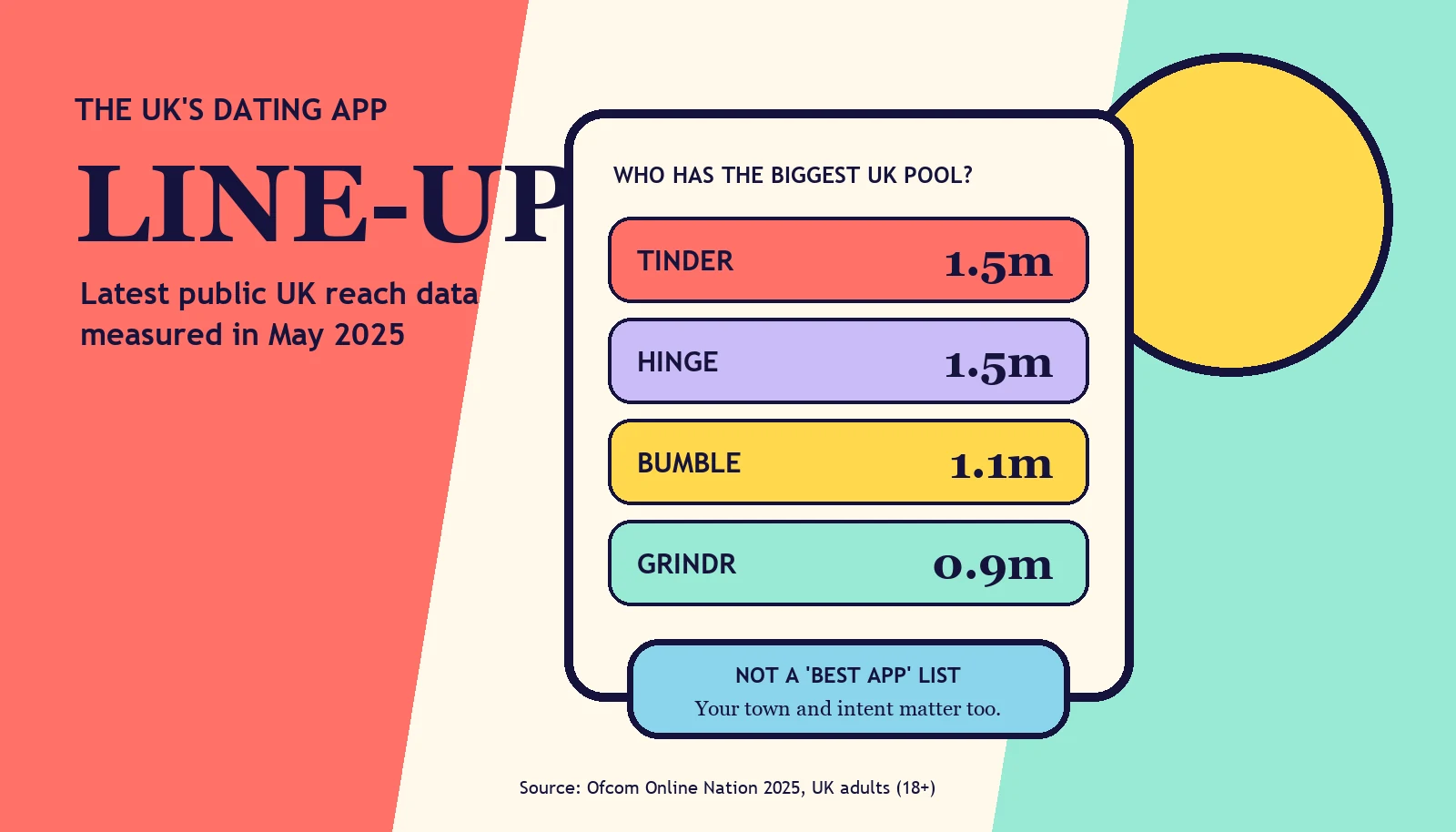
Ofcom's Online Nation 2025 report places Tinder and Hinge jointly first by UK adult reach in May 2025, at roughly 1.5 million each. Bumble followed at 1.1 million and Grindr at 0.9 million. That is useful context, not an instruction to download all four and lose a Sunday afternoon.
| Service | UK adults reached | Useful takeaway |
|---|---|---|
| Tinder | 1.5m | Joint-largest pool in the published data. |
| Hinge | 1.5m | Joint-largest pool; profile prompts give people more to respond to. |
| Bumble | 1.1m | A large mainstream option; check its current conversation settings before joining. |
| Grindr | 0.9m | A major option for many gay, bi, trans and queer people. |
| Badoo / Squirt | 0.5m each | Smaller nationally, but local availability can still be strong. |
| Plenty of Fish | 0.4m | An established service with a smaller measured UK audience. |

How to choose without overthinking it
Start with your intent. If you are open to a relationship, say so plainly. If you want something casual, do not sell a fantasy of candlelit commitment just to get a match. The right app is the one where your profile, your area and your expectations have a fair chance of lining up.
It also helps to understand how dating apps evolved from websites into phone-first products. Their interfaces are built to keep you browsing, so do not mistake a busy screen for progress.
Tinder: biggest name, broadest expectations
Tinder remains a sensible first test if you want the largest general pool. That can mean more choice, but also more people with wildly different intentions. A direct profile and a few specific conversation starters will tell you more than trying to optimise every photo.
If the app suddenly feels unusually busy, it may not mean your luck has changed overnight. Read about Tinder's strange activity surges before assigning destiny to a Tuesday evening.
Hinge and Bumble: prompts, pace and preference
Hinge's more detailed profiles may suit people who prefer to react to an actual thought rather than a perfectly lit bathroom mirror. Bumble remains a major mainstream choice, but app rules and opening features change, so check the current set-up in the app rather than relying on an old article - including this one.
Neither interface can manufacture chemistry. If a profile gives you nothing to say, a different app logo is unlikely to fix it.
Smaller or more specific apps
National rankings can hide what happens locally. A smaller service may be more active in your city, or more relevant to your age group, identity or dating goal. Try one main app and one alternative for a short, deliberate period; then keep the one that produces respectful, useful conversations.
If conversations keep dying before they start, it is worth looking at the habits that make app chats go nowhere rather than endlessly downloading another app.
Safety matters more than a clever matching claim
Do not send money to a match. Move slowly, verify people before meeting and tell someone where you are going. A slick profile is not proof that someone is genuine.
Know the signs of catfishing before a stranger's dramatic emergency becomes your expensive problem.
The UK safety picture is changing too. Ofcom's Online Safety Act guidance sets expectations for robust age assurance on services in scope; it does not mean any particular app is automatically safe. Read Ofcom's age-assurance guidance if you want the regulatory background.
Questions people actually ask
Which dating app has the most users in the UK?
In Ofcom's latest public UK figures, Tinder and Hinge were tied for the largest adult reach at around 1.5 million each in May 2025. That does not guarantee they are the busiest options in your town or for your age group.
Is Hinge better than Tinder for a relationship?
There is no honest universal answer. Hinge gives people more room to write and respond to prompts; Tinder offers a broader general pool. Put your intention in your profile, use both thoughtfully if you wish, and judge them by the quality of conversations rather than a brand promise.
Should I use more than one dating app?
Two is usually plenty. A main app plus one alternative lets you compare the local pool without turning dating into unpaid admin. If neither is producing decent conversations after a fair trial, refresh your profile before chasing a fifth app.
Sources and methodology
This article uses Ofcom's May 2025 UK online-adult audience-reach figures, measured through Ipsos iris. The figures are rounded in the report and are presented here as reach, not as active users or success rates. App features can change frequently, so this guide deliberately avoids pretending that every current setting will remain unchanged.
Which app would you choose?
Keep reading:
See how dating apps became the default way to meet, from the earliest websites to the swipe era.