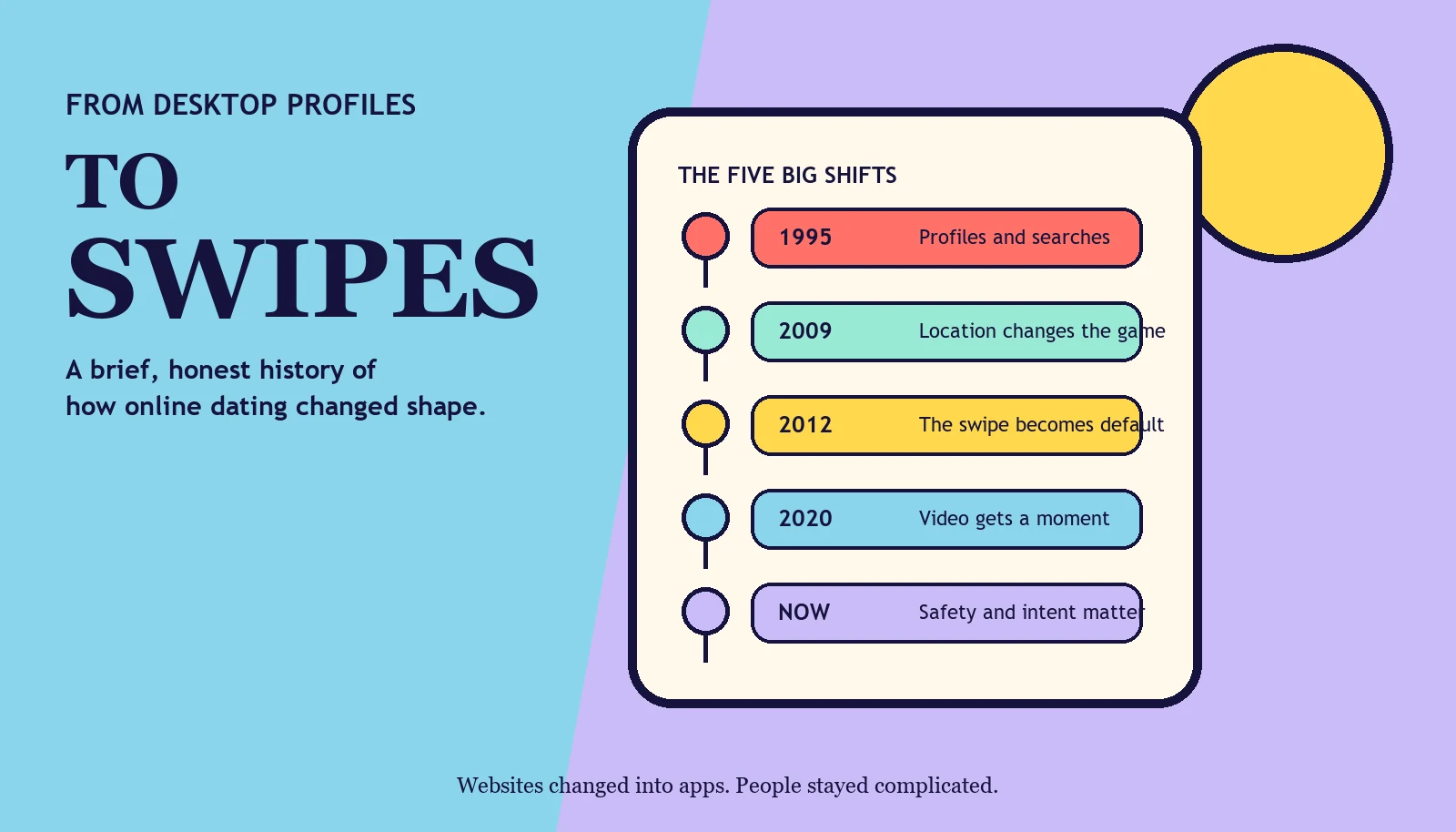
Dating apps did not appear out of nowhere with a tiny flame logo and a request for your location. They grew out of dating websites: profile-heavy, desktop-first places where people searched by age, area and interests. The technology changed shape; the basic problem - meeting someone decent - did not.
This is the short, useful version of the story. It leaves out the made-up AI percentages, imaginary augmented-reality dates and confident predictions about the future. Dating has given us enough fiction already.

Before apps: the profile and search era
Match launched in 1995, making a commercial online dating service feel much less like a futuristic experiment. The early model was simple: create a profile, search a large directory and send a message. It was slower than modern swiping, but it asked people to write something about themselves before anyone had even seen a beach photo.
The 2000s expanded the choice. Compatibility questionnaires, free-to-use sites and more detailed search filters gave people different ways to narrow a huge pool. The biggest shift was not that computers suddenly understood love; it was that online dating became ordinary enough for more people to try it.
1995: profiles make dating searchable
Websites turned dating from a local social network into a searchable database. That was useful, but it also introduced a problem we still have now: when there are too many profiles, people can spend more time browsing than meeting.
Phones change the rules
Smartphones made online dating portable, immediate and much more location-aware. A match no longer had to begin at home on a laptop; it could happen while waiting for a train, avoiding work or pretending you were only checking the weather.
Location-based services gave people a live sense of who was nearby. Tinder, launched in 2012, helped make the quick visual decision - swipe left, swipe right - the dominant pattern. It was not the first dating app, but it made the app-first approach feel normal.
That design is efficient, entertaining and occasionally brutal. If the endless choice starts to feel worse rather than better, read why more features do not automatically make dating apps work.
2012 onward: the swipe becomes the default
The swipe compressed a lot of decision-making into a few seconds. It lowered the effort required to start, but it also made first impressions more image-led. A busy app can feel like momentum even when nobody is actually getting closer to a date.
That is why a sudden rush of attention is worth treating with caution. Tinder's activity spikes are a reminder that app activity and genuine interest are not the same thing.
Different apps, different social rules
As the market grew, apps began to differentiate themselves through their interface and audience rather than inventing a whole new form of romance. Bumble launched in 2014 with a women-first framing and later expanded beyond dating. Hinge positioned fuller profiles and prompts as a way to give people more to talk about. Services for specific communities made it easier for people to find a relevant pool rather than shouting into the general internet.
That is the useful part of having choice: not that one app is universally superior, but that people can choose an environment that better suits their location, identity and intent. The latest public UK reach data still shows large mainstream pools, but it does not tell you which one has the best people in your postcode. For that, see the latest UK dating-app data and trends.
2020s: more attention to trust, not just matching
Video features became more familiar during the pandemic, but the lasting shift is broader: people now expect clearer safety tools, reporting options and better control over how they interact. In the UK, online-safety regulation is also raising expectations around protecting children and managing risk.
Those changes matter, but they are not a substitute for common sense. Do not send money, meet in public first and learn the signs that a profile may be catfishing you.
What has not changed
Better filters and smarter prompts can help people meet. They cannot make someone available, kind, honest or capable of replying to a simple question. Those are still human settings, sadly without an update button.
The current UK market is mature rather than brand new. Ofcom's latest published figures put Tinder and Hinge at roughly 1.5 million UK adults reached each in May 2025, with Bumble and Grindr also reaching large audiences. The point is not that everyone should use the biggest app; it is that online dating is now an established part of how people meet. Read the Ofcom data.
Questions people ask
When did dating apps replace dating websites?
There is no neat handover date. Websites and apps overlap, and many brands operate both. The bigger change was behavioural: smartphones made dating portable and location-aware, so the app became the default starting point for many people.
Did Tinder invent online dating?
No. Online dating had been established for years before Tinder. Tinder's contribution was helping make the fast, visual swipe interface familiar to a huge audience.
Will AI make dating apps better?
It may help with moderation, safety and profile suggestions, but it cannot decide whether two people are compatible. Treat grand claims about AI matchmaking with the same healthy scepticism you would apply to an over-edited profile photo.
Sources and further reading
This refresh uses company history pages for the major platform milestones and Ofcom for current UK audience data. Features change quickly, so the article focuses on durable shifts rather than promising that a particular button or rule still exists today.
- Match: company history
- Match Group: company timeline
- Bumble: company timeline
- Ofcom: Online Nation 2025 report
Did this history surprise you?
Keep reading:
Find out which dating preferences are flexible - and which standards are worth keeping.